How AI Is Changing the Requirements for Content Management Systems
Artificial intelligence is fundamentally changing how websites are built and maintained. What used to require extensive programming can today be partly automated by AI agents. But not every content management system offers the same conditions for this. TYPO3, the open-source enterprise CMS, has characteristics that make it particularly well-suited for working with AI – and could therefore become an economically attractive alternative to WordPress and classic website builders, even for smaller companies and startups.
Until now, criteria like usability, feature scope, design options, and cost were the main factors in choosing a CMS.
With the growing use of artificial intelligence, another aspect is now added: how well can a system be analyzed, modified, extended, and operated automatically by AI?
Modern AI agents can do far more than write text or generate images these days. They can write program code, analyze database structures, develop interfaces, implement designs, and optimize existing software.
For these possibilities to be fully exploited, the underlying CMS needs to be as open, flexible, and transparent as possible.
This is exactly where TYPO3 plays to its strengths.
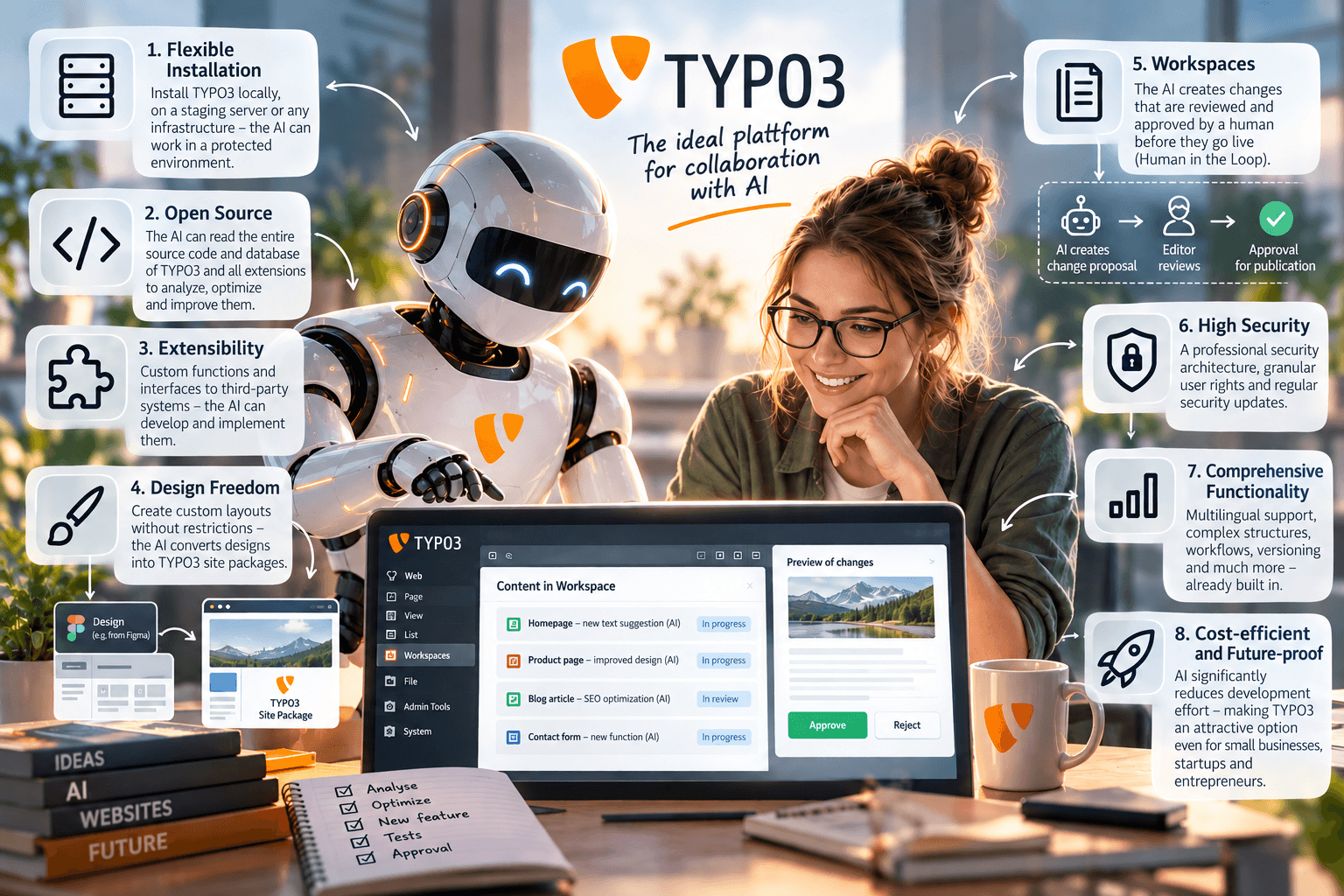
1. Full Control: TYPO3 Can Be Installed Anywhere
A decisive advantage of TYPO3 is its independence from specific hosting providers or platforms.
TYPO3 can run on almost any suitable server infrastructure – from classic web hosting to cloud servers to local development environments on your own computer.
This is especially valuable for working with AI.
An AI agent can, for example, work on a local TYPO3 installation without having access to the publicly reachable production system.
There, the AI can:
- develop new features,
- modify existing extensions,
- optimize templates and designs,
- analyze database structures,
- fix bugs, and
- prepare updates.
All changes can first be tested in a protected development or staging environment.
Only after successful review are they transferred to the live system.
The decisive advantage: the AI can work extensively on a website without immediately endangering live content or ongoing operations.
With many proprietary website builders, this kind of independent development isn't possible, or only to a limited extent.
2. Open Source: AI Can Understand the Entire System
TYPO3 is fully open source. The CMS's source code is freely available and can be examined, modified, and extended.
That's a significant advantage for AI-assisted software development.
While proprietary systems often only expose certain functions through their user interface or provided APIs, a sufficiently authorized AI can access TYPO3's program code directly.
It can understand how the system works internally, which classes and functions are used, and how individual components interact.
This generally also applies to the many freely available TYPO3 extensions. Access to individual or commercial extensions depends on their licensing and distribution.
The database structure can be analyzed too, provided the appropriate access rights exist.
This opens up far-reaching possibilities:
The AI doesn't have to limit itself to operating existing functions. It can further develop the system itself.
Another advantage is independence from individual software vendors. Companies retain control over their code, their data, and their technical infrastructure.
Especially in the age of AI agents, this digital sovereignty could become significantly more important.
3. Extensibility: AI Can Develop Custom Functionality
TYPO3 has a powerful extension architecture.
With custom extensions, almost any additional functionality can be implemented. This includes, for example:
- custom forms and database applications,
- interfaces to CRM, ERP, or inventory management systems,
- automated data imports and exports,
- connections to external web services,
- custom booking and management functions,
- AI-assisted content analysis, and
- automated editorial processes.
Many of these tasks used to require extensive programming knowledge and corresponding development budgets.
AI can significantly speed up the development of such extensions.
In doing so, it benefits from TYPO3's documented architecture, established development standards, and existing interfaces.
Interoperability is especially interesting here: TYPO3 can be connected to a wide variety of third-party systems and can thus become a central part of a company's digital infrastructure.
A classic CMS becomes a flexibly extensible platform whose feature set can be adapted to individual requirements comparatively cost-effectively with the help of AI.
WordPress, too, can be extended through plugins and custom programming. TYPO3, however, already offers an extensive technical foundation, particularly for complex, multilingual, and editorially demanding applications.
4. Design Freedom: AI Can Implement Custom Layouts Without Restrictions
Many website builders advertise particularly simple website design.
That simplicity often comes at a price, though: the design options are built around predefined templates, components, and features.
TYPO3 doesn't have these kinds of fundamental design restrictions.
A website's appearance can be developed entirely custom with HTML, CSS, and JavaScript, and integrated into TYPO3 via so-called sitepackages.
This opens up interesting possibilities for AI.
Starting from a design draft – for example from Figma – or an existing website, an AI agent can create the necessary templates, stylesheets, and configurations.
Implementing responsive layouts for smartphones, tablets, and desktop computers can be supported this way too.
In doing so, the AI isn't tied to the components of a specific website builder.
The design is guided by the company's requirements – not by the limitations of the software.
TYPO3 thus enables largely unrestricted design freedom, which can increasingly be used efficiently with the help of AI.
5. Workspaces: AI Works, the Human Decides
A particularly interesting advantage of TYPO3 is the integrable Workspaces module.
It lets editorial changes be made first in a separate working environment, without them immediately appearing on the public website.
Multi-stage approval processes can be set up in addition.
This functionality is excellently suited for working with AI agents.
One possible scenario:
An AI agent regularly analyzes a website's content and identifies potential improvements in terms of search engine optimization, clarity, timeliness, or accessibility.
It then creates concrete change proposals and saves them, via a purpose-built interface, in a TYPO3 workspace.
A responsible editor reviews the changes and decides which content gets published.
This principle is called "human in the loop."
The AI takes over time-consuming work, while the final decision stays with the human.
This is a decisive advantage especially for companies, public authorities, academic institutions, and other organizations with high quality requirements.
It's important to distinguish between editorial and technical changes here: Workspaces are designed for versioning and approving supported content and records. Changes to program code still need to be controlled through suitable development, testing, and deployment processes.
TYPO3 thus creates excellent conditions for combining AI automation with human quality control.
6. Security: An Important Prerequisite for Using AI Agents
When AI agents don't just create content but actively make changes to websites, the security of the CMS becomes even more important.
After all, access rights, database operations, and publishing processes need to be reliably controlled.
TYPO3 was built from the ground up for demanding, professional use cases.
Its strengths include, among others:
- a granular user and permissions system,
- support for two-factor authentication,
- extensive options for restricting access,
- a dedicated security team,
- structured security advisories and regular updates, and
- long-term, plannable maintenance cycles.
The granular permissions system in particular is interesting for AI applications.
An AI agent doesn't necessarily need full administrator rights. Instead, its permissions can be specifically restricted to certain tasks and content.
Secure installations can be achieved with WordPress too. However, many more advanced features are provided through additional plugins. This can create further dependencies and maintenance requirements.
For numerous professional requirements, TYPO3 already offers an extensive foundation in its core system or through official system extensions.
That doesn't mean TYPO3 is automatically secure or that WordPress is inherently insecure. What matters is proper configuration, regular updates, and a well-thought-out permissions concept.
Especially when integrating autonomously operating AI agents, a controllable, long-term maintainable system architecture is a significant advantage.
7. Extensive Enterprise Features Already Built In
Another important aspect is often overlooked in discussions about AI and content management systems:
The more functionality a CMS already brings along, the less needs to be additionally developed or added through extensions.
TYPO3 already offers numerous features out of the box, or through official system components, that often still need to be retrofitted on simpler CMS installations.
These include, for example:
- extensive multilingual support,
- complex page and content structures,
- granular user permissions,
- editorial approval processes,
- versioning and change history,
- scheduled publishing,
- structured content types, and
- diverse integration options.
These features aren't only interesting for large companies.
Smaller organizations can benefit too, especially if their website is meant to grow over the long term.
For AI agents, this existing functionality also means they can rely on proven structures instead of having to build basic features from scratch.
8. AI Is Changing TYPO3's Economics
In the past, TYPO3 was often considered a powerful but comparatively elaborate CMS.
Developing custom templates, programming extensions, and the technical setup required specialized expertise.
For smaller companies and founders, website builders or simple WordPress installations therefore often seemed economically more attractive.
The use of AI could fundamentally change this balance.
When AI agents take over or accelerate a significant part of the development work, the time required for numerous typical tasks decreases.
This affects, for example, building sitepackages, developing custom extensions, integrating interfaces, or technically optimizing existing websites.
This doesn't make experienced TYPO3 developers' work obsolete. It increasingly shifts toward architecture, conception, quality assurance, security, and reviewing AI-generated results.
Still, the economic effect can be considerable.
A CMS that used to be deployed mainly on larger projects because of the development effort involved becomes interesting for smaller budgets too.
On top of that, TYPO3 itself can be used without license fees.
Companies thus invest in the development, operation, and care of their website – not in a proprietary software license.
In the long run, they also benefit from being able to further develop their website independently and switch provider or hosting partner if needed.
Conclusion: TYPO3 and AI – Enterprise Technology Becomes Affordable for Everyone
Artificial intelligence isn't just changing the way websites are built. It could also fundamentally shift the economic gap that has traditionally existed between simple website builders and powerful enterprise CMS platforms.
TYPO3 brings excellent conditions for this.
Full control over the hosting environment, open source code, extensive extensibility, unrestricted design freedom, and built-in options for editorial quality assurance form a powerful foundation for AI-assisted development and automation.
On top of that come a professional security architecture and numerous features that simpler systems can only achieve through additional extensions.
What matters most: AI is making the use of this powerful technology increasingly economical.
This makes TYPO3 an interesting alternative to proprietary website builders and simple WordPress installations – for small businesses, freelancers, founders, and startups too.
Anyone planning a website today shouldn't only ask which system is currently the easiest to use.
A much more important question might be:
Which CMS offers the best conditions for making full use of the possibilities of artificial intelligence in the future, too?
TYPO3 has convincing answers to that.